
At Northern House, we take pride in our mission to reshape the identities and perceptions of our learners, support our families to build trust, and ensure that all feel valued and included as part of our community. We will, through our ethos, guarantee that all achievements will be shared and celebrated, no matter how minor they may seem, and to maximise our pupils’ opportunities to develop and grow as individuals, so that they can leave Northern House Academy as well rounded and happy children, confident in their own abilities.
Our pupils have huge potential to succeed. We believe that our approach of attributing equal value to Personal and Academic Development , the structure of the school day and our curriculum can enable all pupils to experience success during their time at Northern House Academy and be prepared for their next phase of education.
We attribute equal value to Personal and Academic Development of our pupils. We recognise that, until pupil’s primary needs are met, that they feel safe and happy, they will be unable to make maximum progress academically. Our intent is to be the catalyst for change by creating a positive and safe learning environment. We will achieve this through our values being the key drivers within our curriculum. They will drive every minute of every day to ensure we provide the utmost opportunities for our pupils to be ready for their next stage of education.

Our values encompass the specific needs of our cohort. They provide a foundation upon which continuous improvement takes place and they drive all aspects of our future development.

These values are fundamental in shaping not just our curriculum but our school, our community, our psychology, one that enables all its learners, no matter their starting points, to fulfil their potential. They form the framework of our values-led practice, ensuring that our daily interactions, our responses to behaviours, our everyday practice and culture are driven and shaped by our values. They are embedded within the DNA of our school and are an essential part of our decision-making processes. From morning routines to curriculum development, every choice we make, whether strategic or dynamic, is informed and guided by our values.
The specific needs of our pupils always remain at the forefront of our minds and our curriculum framework stays true to this vision:
- Our curriculum embodies our value-led practice and is embedded with the highest of expectations and aspirations for each pupil
- Our curriculum is knowledge and skills based to enable rich learning
- Our curriculum is centred around understanding the bespoke needs of each individual child
- Our curriculum is knowledge rich, systematic and progressive.
- It provides teachers with the systems and tools they need to understand individual pupil needs to ensure high quality teaching and learning.
- It is unapologetic in its high expectations of pupils, knowing that our children are not defined by their needs but instead viewed with the positivity they need in order to be nurtured, both emotionally and academically.
- It is consistent, in both approach and delivery, thus helping to create a psychologically safe environment where our pupils are empowered to take risks and experience success.
- It is a curriculum of hope, restoration and healing, which promotes and prioritises the happiness of our students above all else.
Our values-led curriculum places the emphasis not solely on the academic attainment and end goals of specific subject areas, but instead on the development and progress of the whole child, their cultural capital and their individual journey.
Our curriculum areas can be found on our website under learning. Here you will see subject overviews and progression documents. You will also find examples within our enrichment framework to build our pupils’ cultural capital. For example, our pupils experience enrichment activities in partnership with the local independent school and all pupils will experience residential opportunities.
Our intent informs our teaching and learning policy, which considers key research such as Cognitive Load Theory, which stresses the importance of activating prior knowledge before sharing key information with students (Hart & Wickens, 2012).
The curriculum has been informed and mapped by the National Curriculum and our local context. It is progressive and runs on a two-year cycle which meets the nature of the cohort of the school e.g a pupil will be in a school gallery class for two years.
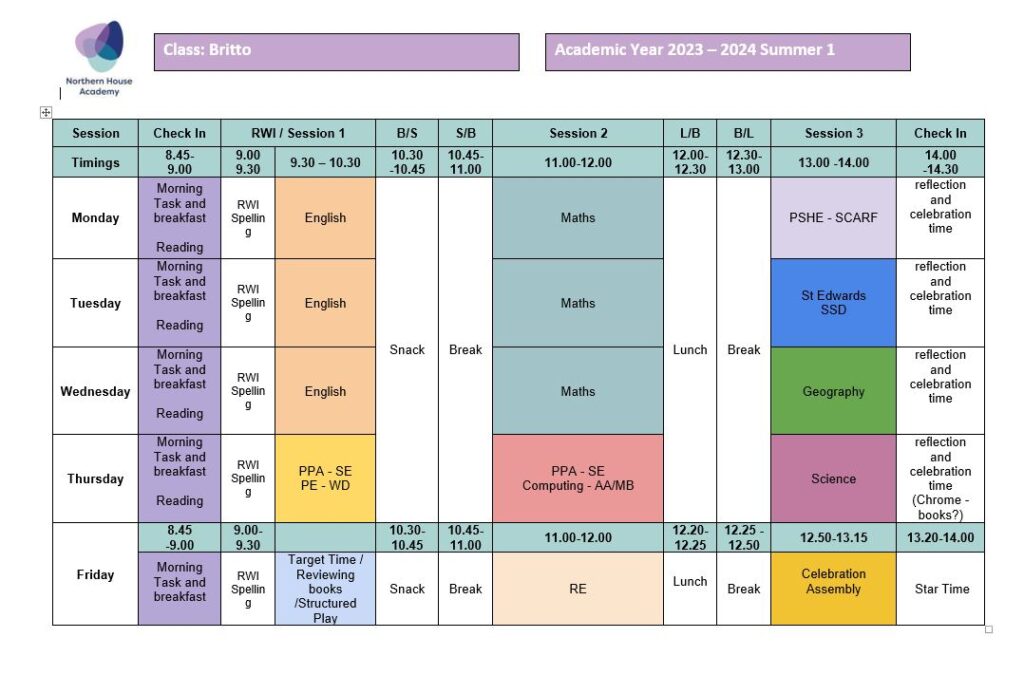
The curriculum subject weightings and the structure of the day are informed by EHCP outcomes for every student in the school. For example, PSHE, which is seen as a core subject within the school, is given equal weighting to other core subjects. At the end of the school day we ensure there is a restorative/reflective session to enable each pupil to reflect on their day of learning, celebrating their achievements and ensuring closure to any challenges they may have faced in line with our value of nurture.
Please see an example of a timetable to demonstrate our subject weighting:
The impact of our curriculum is measured through our formative and summative assessment processes. The EHCP outcomes feed directly into termly objectives (TOPs), which then feed into lesson series objectives that inform our planning to meet pupil needs. These are assessed regularly to inform half term summative assessments.

We also gather both quantitative and qualitative information to inform the impact of our curriculum on pupils’ attitudes to learning. Parent, Pupil and staff voice alongside data informs the impact of our curriculum on the achievement of our pupils in line with our intent.
At NHA we want our pupils to thrive within education and to optimise their development as individuals, both academically and socially. The Northern House Academy Curriculum supports the whole child by being carefully weighted and designed to meet individual pupils’ EHCP Outcomes, whilst ensuring that all students have access to a wide breadth of curriculum coverage. It is academically robust and draws on elements of the National Curriculum in order to ensure our learners are provided with a broad and balanced offer. This is achieved by providing students with opportunities to make progress in all subject areas within a curriculum which is enriched by cross curricular links, embedded within real life experiences, and underpinned by a comprehensive programme of cultural capital opportunities.
Our curriculum intent, implementation and evolution is driven by our values of happiness, positivity, high expectations, understanding, consistency and nurture. These values were constructed in order to meet the specific needs of our cohort and utilising them as the bedrock of our curriculum offer ensures all of our learners, from their unique and varied backgrounds, are able to embrace their differences and truly understand that ‘the learning is in the challenge’.
We are mindful of the journey our pupils have undertaken and the effect this will likely have had on their educational attainment, attitudes to education and relationships with adults within educational settings. The priority during a student’s first term with us is establishing positive relationships with them and their family, creating a positive association with our school and getting to know them. We understand that positive relationships are the foundation of all student progress and are integral to enabling our students to experience success.
Within our setting, support staff play an integral and comprehensive role. We typically have class sizes of 9-10 pupils with one teacher and 2-3 support staff per class allowing us to offer lots of reasonable adjustments to meet our pupils’ specific needs. Our thematic curriculum runs termly with each pupil having their own bespoke termly learning outcomes linked to the ‘Northern House Academy Learning Steps’ or ‘Northern House Academy Ready to Progress Steps’. Success Criteria for a pupil is tracked and assessed across a term and students are assessed in each lesson and the amount of support they receive in the session is recorded on a planning and assessment ‘Front Sheet’, along with any other noteworthy information. Teachers, teaching assistants, and class based pastoral support workers will typically work with small groups of 1-3 students within a lesson, with each student potentially working towards a different objective whilst accessing shared learning experiences.
Upon arrival at our academy, all pupils are baseline assessed using a variety of assessments in order to obtain an accurate understanding of their individual starting points. The triangulation of these assessments enables us to form an up to date, bespoke picture of each student and gain a comprehensive understanding of their areas for academic and social development. It is through this approach that we are able to create a truly differentiated offer for each of our students comprising personalised learning targets, bespoke interventions and enrichment opportunities as well as linking to EHCP outcomes.
NHA’s Universal Enrichment Offer gives our children opportunities to try new and varied activities embedded into their curriculum, that develop character, resilience and motivation, and encourage them to pursue wider goals while gaining life skills that benefit them beyond the classroom. At Northern House Academy we are committed to providing our students with opportunities throughout their time at school which develop their awareness of the wider world and the communities they live in. Our pledge is to ensure that all pupils experience a range of opportunities and experiences which will support their growth and development.
Enrichment Pledge:
- All pupils will have the opportunity to experience a range of residential trips (see below)
- All pupils will take part in whole school curriculum enrichment days such as ‘Children in Need’, ‘World Book Day’, ‘R.E celebration events and workshops’, ‘Author Visits’
- All pupils will visit Hill End (Forest School) to take part in a variety of activities
- All pupils will have the opportunity to take part in partnership work with St Edwards’ school
- All pupils will take part in school trips – locally or further afield
- All pupils will experience age appropriate Pantomime and Christmas events
- ‘Star Treat’ days
- Student council opportunities
We have three Galleries within our school:
Tate (KS1): A gallery for our youngest pupils and those who benefit from having time to learn how to be successful in a classroom. A focus on enabling pupils to learn how to be positive classmates and understand key behaviours for learning is crucial for those who join the school at this age. As well as a rich and robust curriculum designed around KS1 national curriculum learning experiences, the pupils in this gallery benefit from an emphasis on social and emotional support and development. The utilisation of early years style continuous provision during the first part of the academic year enables these pupils to learn how to see themselves as successful learners and positive members of a school community. These pupils will benefit from visual timetables, now and next displays, segmented learning and plenty of opportunities for structured play, as they gain increasing exposure and experience of more formalised learning approaches as they year progresses. Pupils in this gallery where appropriate work towards completing the Phonics Screening Check. Tate Gallery – 2 Year Plan
Louvre (LKS2): A gallery for pupils who are chronologically in year 3 and 4, or who benefit from a nurture-based curriculum with formalised learning embedded into daily practice. The learning in this gallery is closely matched to the national curriculum via thematic topics and an exciting cultural capital programme. Pupils in this gallery are establishing a more developed understanding of their own social and emotional journey and the curriculum is weighted to reflect this, offering opportunities for structured social development weekly and PSHE sessions focused around individual class needs and pupils own SEMH targets and goals. Pupils in this gallery may continue to develop their phonic understanding, however they may also be ready to move to Age Related Spelling programmes within Read, Write Inc.. Pupils in this gallery work towards sitting the Year 4 Times Table test and learning key skills needed for those on a Year 6 SAT pathway. Louvre Gallery – 2 Year Plan
Moma (UKS2): A gallery for our eldest children, students within Moma are coming to the end of their journey with us. Some of our pupils experience early integration programmes to their chosen and identified secondary setting, or experience reintegration into mainstream classrooms and primary settings to support their individual progression pathway. Many of the pupils in this gallery sit their Year 6 SATS and work within a robust and exciting curriculum rich in real life and cultural capital experience, designed to support our pupils in building lifelong memories that reflect a love of learning and a renewed positive sense of self. Pupils in Moma demonstrate positive behaviours for learning and model this to other students around the school. Some Moma students support our youngest learners in peer mentoring sessions or take on additional responsibilities around the school. The curriculum is closely matched to the national curriculum and continues to provide students with an array of intervention support in order to fill any remaining gaps in their learning. Moma Gallery – 2 Year Plan
Within the structure outlined above, all classes utilise the Gallery Toolkit. This is a selection of resources that comprise the design of classrooms across the school and equip classroom teams with a set of restorative de-escalation tools to support the students within their class.
These tools include:
Visual timetable:
- Routine and clear expectations for the day.
- Helps to create security and promotes feelings of safety.
- Consistent picture prompts help students with low levels of literacy to access and understand this resource.
Learning Passports:
- Helps to promote reflection.
- Chance to celebrate success.
- Creates physical transition points.
- Provides teachers with language to use when supporting pupils.
- Learning Passports Good Practice and Guidance Document
Now and Next Boards:
- Helps to break up the day into manageable chunks.
- Offers incentives to support engagement.
Class Celebrations:
- Celebrates success for all.
- Fosters sense of community.
- Highlights and reinforces positive behaviour/learning choices.
- Prompts feelings of acceptance and validation.
Emotional Check-ins:
- Starts to support development of emotional literacy.
- Promotes understanding that all feelings are valid.
- Creates Physical Transition points between lessons and activities
- Emotional Check-ins Good Practice and Guidance Documents
Mend it Meetings:
- Promotes Restorative Practices.
- Focuses on relationship building.
- Enables conflicts to be resolved with definitive outcomes.
Brain Breaks:
- Allows a pupil to be heard.
- Takes account of pupils’ individual needs while empowering class adults to be seen as maintaining control.
- Prompts reflection and starts the process of self identification of triggers, thoughts, feelings and emotions.
These tools were developed to ensure that we provide our students with persistent exposure to opportunities that will develop their emotional literacy. The utilisation of these tools within all classes ensures that we provide maximal opportunity and consistency to do this throughout their school life. They form part of our universal offer for all students.